




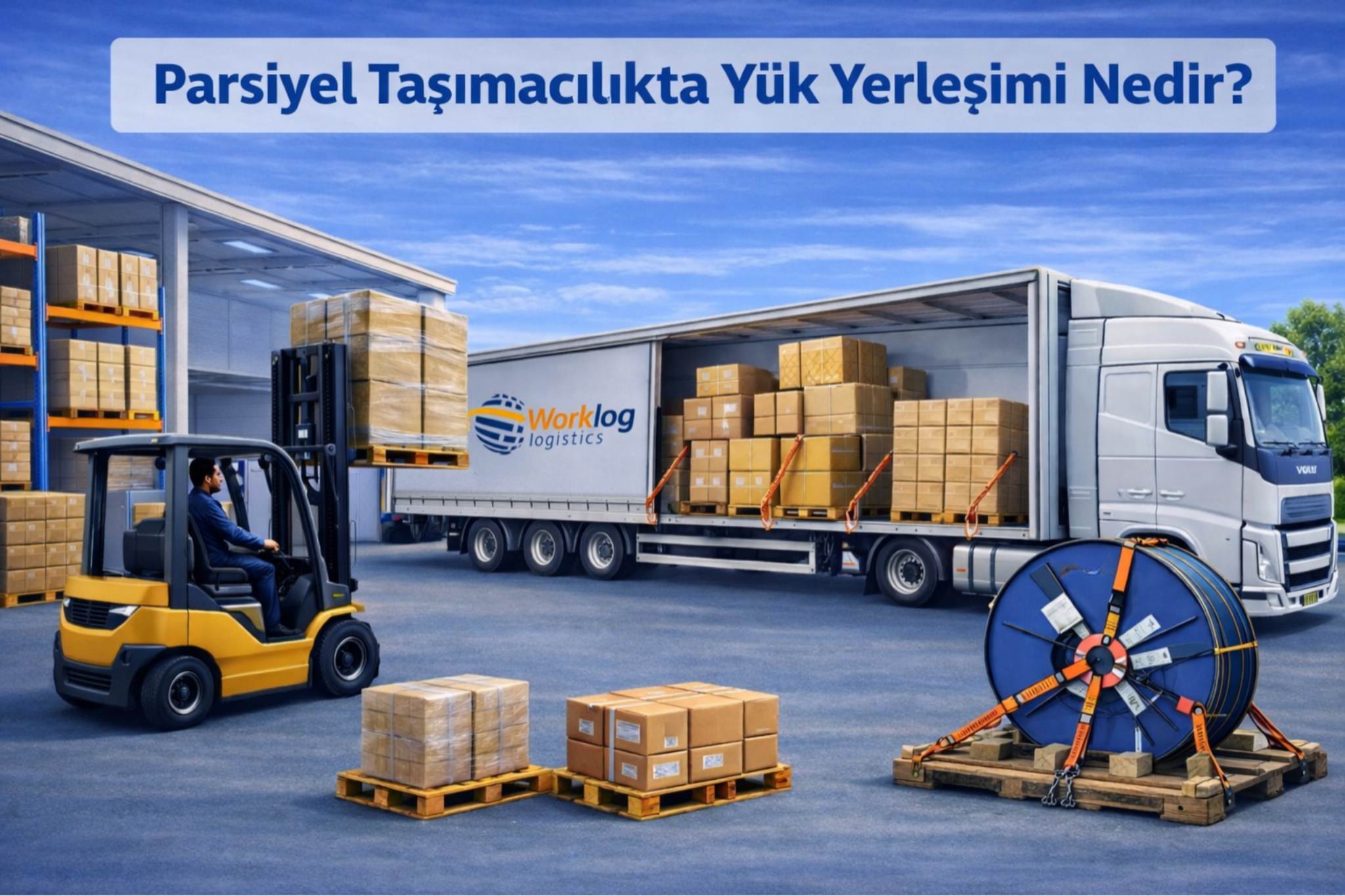
Why Is Cargo Placement Important in Partial (LTL) Transportation?
In partial transportation, the success of an operation is not determined solely by the vehicle departing on time, but is directly linked to how cargo is placed inside the vehicle.
Cargo placement plays a decisive role in delivery sequence, cargo safety, vehicle space utilization, operational efficiency, waiting times, and indirect costs.
This article examines why cargo placement is critical in partial transportation, how occupied space is calculated, and how proper placement indirectly affects pricing.
What Is Cargo Placement in Partial Transportation?
Cargo placement refers to the process of positioning shipments from different consignors within a vehicle by considering volume, weight, sensitivity, stackability, and the operational plan.
This process is not merely about filling empty space; it is a technical planning activity aimed at using vehicle capacity safely and efficiently.
Proper cargo placement is one of the fundamental building blocks of partial transportation.
Volume and Weight Balance
Maintaining balance inside the vehicle is crucial in partial transportation. Cargo placement must take into account:
- Volumetric dimensions
- Evaluation in m³ or LDM
- Balanced weight distribution within the vehicle
It is essential to correctly identify whether cargo is stackable or non-stackable. Failure to do so increases the risk of damage. During vehicle disposition planning, the cargo pool must be reviewed carefully, and incompatible goods (such as chemicals and food products) must be separated.
For this reason, some shipments may be scheduled for the next departure until proper balance can be achieved.
Positioning Fragile and Sensitive Cargo
In partial transportation, transported goods vary significantly in structure and sensitivity. Cargo such as chemicals, food products, machinery, glassware, textiles, finished or semi-finished goods requires more careful placement planning.
These cargo types are generally classified as:
- Stackable base cargo
- Non-stackable, fragile, or lightweight boxed cargo
- Cargo requiring fixation and securing
Ensuring that cargo supports each other within the vehicle directly affects the overall placement plan and departure organization.
Palletized vs. Non-Palletized Cargo
Palletized cargo provides standardized dimensions and stability, whereas non-palletized or irregularly shaped cargo requires more complex space planning inside the vehicle. This directly impacts:
- Stacking possibilities
- Loading sequence
- Vehicle space efficiency
Stackable and non-stackable cargo must be planned in the correct combination. Non-palletized cargo may limit the effective use of vehicle capacity.
Loading Order Is Not the Same as Delivery Order
One of the most common misconceptions in partial transportation is assuming that the loading order must match the delivery order. In practice:
- Cargo to be delivered later may be loaded earlier
- Cargo requiring early delivery may be positioned for easier access
- Loading is generally planned so that last deliveries are placed at the rear and first deliveries at the front
This approach ensures safe and controlled operations.
How Much Space Does Cargo Occupy in Partial Transportation?
In partial transportation, cargo is evaluated not only by its weight (kg) but also by the space it occupies (volume). Therefore, space calculation is a core element of cargo placement planning.
Cost calculations typically consider:
- m³ for stackable cargo
- LDM for non-stackable cargo
- kg (tonnage-based) for heavy base cargo
For light but voluminous cargo, occupied space rather than actual weight becomes the determining factor.
What Is Volumetric Weight?
Volumetric weight represents the impact of occupied space on transportation cost. In partial transportation pricing:
- Stackable cargo is priced per m³
- Non-stackable cargo is priced per LDM
- Tonnage-based cargo is treated as base load
In road partial transportation, a commonly used standard is:
1 m³ ≈ 333 kg
(This coefficient may vary depending on route and operational conditions.)
How Are Volume and Volumetric Weight Calculated?
Volume (m³) Calculation:
m³ = Length × Width × Height
Common reference values:
- 1 m³ ≈ 333 kg
- 1 LDM ≈ 1,750 kg
Indirect Impact of Cargo Placement on Pricing
In partial transportation, pricing is not determined directly by cargo placement; however, placement has a significant indirect impact on costs.
Factors affecting pricing include:
- Volume occupied by m³ cargo
- Vehicle space allocation of LDM cargo
- Vehicle dimensions (13.60 × 2.45 × 2.85 m)
- Maximum payload capacity (typically 0–22 tons)
Due to these variables, partial transportation costs may vary.
How Should Space and Pricing Balance Be Managed in Partial Transportation?
For a healthy partial transportation operation:
- Cargo dimensions must be measured accurately and completely
- Volume and physical characteristics must be evaluated in advance
- Placement planning should be aligned with vehicle load efficiency
Once the planned load factor is achieved, freight discounts of up to 30% may be applied. This approach reduces operational surprises and improves expectation management.
Conclusion
In partial transportation, cargo placement is critical not only for transport safety but also for space utilization, operational efficiency, and indirect costs. The amount of space cargo occupies and how it is positioned within the vehicle affects the entire operation.
Proper loading, efficient vehicle utilization, accurate disposition, and correct cost calculation are key factors that can create either a competitive advantage or disadvantage in partial transportation.